


If I Hear “Wear and Tear” One More Time, I’m Flipping the Table! Chronic Pain & Language

Updated: Jan 23
Imagine you walk into a consultation, and your healthcare provider frowns at your scan results.
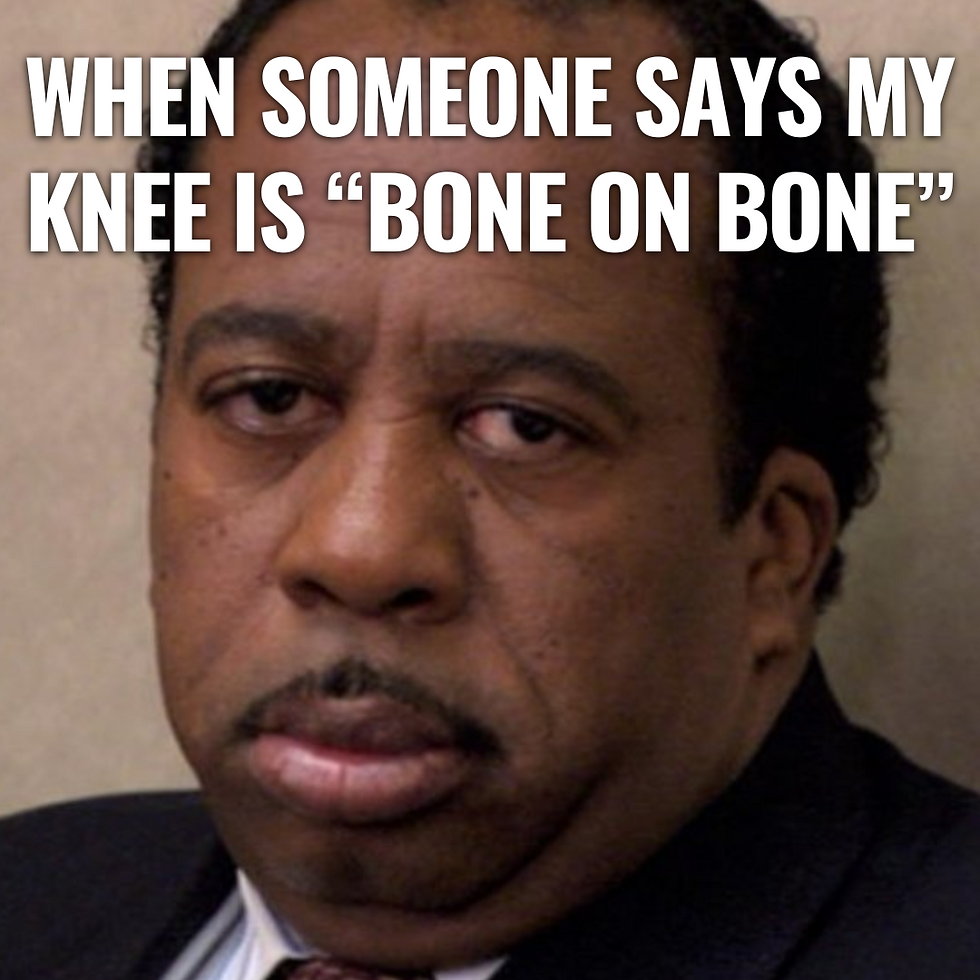
"Your spine looks like that of a 90-year-old," they say. Or perhaps they tell you your knee is "bone on bone" and you "need to be careful!"
How would you feel?
For many, these words create fear, uncertainty, and a sense of helplessness. Suddenly, the pain feels more threatening, the body more fragile, and the idea of moving safely a lot more daunting.
But what if the same situation was framed differently? What if you were told, "There are some normal age-related changes here, but your body is strong and adaptable—we can work together to improve your movement and comfort."
The words we hear—and the words we use—have the power to shape our experience of pain.
More Than Words
Our brains are constantly processing information, trying to make sense of our experiences. Pain isn’t just a signal from the body—it’s an interpretation by the brain, influenced by beliefs, emotions, and past experiences.
There’s a reason why phrases like "wear and tear" and "bone on bone" are so common. They rhyme, they use alliteration, and they’re easy to remember—our clever brains latch onto them without question. But what we learnt in Year 8 English about catchy phrasing has a much bigger impact than we might realise—it can shape our perception of our own bodies.
Pain science research shows that the way pain is described can actually change how it is experienced. Certain words can heighten the brain’s threat response, increasing pain sensitivity. This is known as the nocebo effect—the opposite of a placebo.
When someone is told their condition is “degenerative” or “incurable,” they often experience more pain and distress—even if their actual physical state hasn’t worsened.
On the flip side, positive, accurate, and empowering language can reduce threat, improve confidence, and help people feel safer in their bodies.
The Danger of 'Damage Talk'
A common trap in healthcare and everyday conversations is ‘damage talk’—catastrophic language that suggests the body is weak, broken, or beyond repair.
One of my personal favourites (or rather, most despised!) is “Your disc has slipped.” I can’t count the number of times a client has said, “Well, my doctor told me my disc has slipped.”
When I ask them what they imagine that means, they often describe something alarming—like a disc sitting outside the spine or slipping away like a bar of soap in the shower. If I believed my disc looked like that, I’d probably hesitate before every single movement too!
As healthcare professionals, we have a responsibility to be mindful of the words we use. What we say carries weight—these phrases can become deeply ingrained beliefs about the body, affecting behaviour, movement, and ultimately, pain.
This is where reframing can make a huge difference.
Let's Reframe
Instead of “Wear and tear” → “Normal age-related changes” “Your joints have adapted over time, just like wrinkles on the skin. Movement helps keep them strong and healthy.”
Instead of “Bone on bone” → “Structural changes that we can work with”🔹 “There are changes in your joint space, but your muscles and movement patterns can help support your function.”
Instead of “Your back is out of alignment” → “Your back is strong and adaptable” “Your spine is designed to move in many directions—let’s work on making movement feel more comfortable.”
Instead of “Your disc has slipped” → “Your back is experiencing sensitivity, but discs don’t slip” “Your disc may have some changes, but your spine is stable, and movement can help reduce sensitivity.”
Instead of “Your core is weak, that’s why you have pain” → “Strength can help, but pain is more complex than just core muscles” “Building strength is great for movement, but pain is influenced by many factors—we’ll take a holistic approach.”
Instead of “You have a degenerative condition” → “Your body is always adapting” “These are natural changes over time, and we can focus on strategies to help you stay active and comfortable.”
Final Thoughts
Pain is complex, and no single approach works for everyone. But one thing is clear: the messages we receive about our bodies matter.
Whether it’s from a doctor, a family member, or even our internal dialogue, the words we use can either reinforce fear or promote resilience.
So next time you talk about pain—your own or someone else’s—pause and consider:
Are these words helping or hindering recovery?
By shifting the conversation, we can help retrain the brain’s perception of pain, making space for confidence, movement, and a more positive experience of healing.
References:
Hadjistavropoulos, T., Craig, K. D., Duck, S., Cano, A., Goubert, L., Jackson, P. L., Mogil, J. S., Rainville, P., Sullivan, M. J. L., de C. Williams, A. C., Vervoort, T., Fitzgerald, T. D., & Hinshaw, S. P. (2011). A Biopsychosocial Formulation of Pain Communication. Psychological Bulletin, 137(6), 910–939. https://doi.org/10.1037/a0023876
van Rysewyk, S. (2023). A perspective on the role of language about pain. Frontiers in Pain Research (Lausanne, Switzerland), 4, 1251676–1251676. https://doi.org/10.3389/fpain.2023.1251676
Wilson, D., Williams, M., & Butler, D. (2009). Language and the pain experience. Physiotherapy Research International : The Journal for Researchers and Clinicians in Physical Therapy, 14(1), 56–65. https://doi.org/10.1002/pri.424

Comments